
 St Mark's Primary School



Bullying
St Mark’s Primary School is an Anti-Bullying School. Bullying is unacceptable and will not be tolerated. Any bullying brought to our attention is dealt with promptly and effectively. We are committed to ensuring every child feels safe, valued and supported.
Our school takes a proactive whole school and pupil-led approach. The school's anti-bullying culture is widely accepted and is an integral part of every day life at St Mark's.
What is bullying?
Bullying refers to the use of force, coercion, hurtful teasing, or threats to abuse, intimidate, or aggressively dominate another person. While bullying can happen to anyone at any age, it is typically experienced most often during childhood and adolescent years. Bullying is different from simple disagreements, fallings out or fights; a power imbalance must exist for a situation to be considered bullying along with these hurtful behaviours being repeated over a period of time.
Our Anti-Bullying Ambassadors define bullying by the following three characteristics:
- Repeated: A bully bothers the same person repeatedly.
- Intentional: A bully hurts someone on purpose, not accidentally.
- Power Imbalance: The bully has more power (through characteristics such as size, popularity, age, etc.) than the other person.
Acts of bullying can take many forms, for example:
- Physical - pushing, poking, kicking, hitting, biting, pinching etc.
- Verbal - name calling, sarcasm, spreading rumours, threats, teasing, belittling.
- Emotional - isolating others, tormenting, hiding books, threatening gestures, ridicule, humiliation, intimidating, excluding, manipulation, and coercion.
- Sexual - unwanted physical contact, inappropriate touching, abusive comments, homophobic abuse, exposure to inappropriate films etc.
- Online / Cyber - posting on social media, sharing photos, sending nasty text messages, social exclusion.
- Indirect - can include the exploitation of individuals.
The Department of Education states:
‘Bullying, especially if left unaddressed, can have a devastating effect on individuals. It can be a barrier to their learning and have profound consequences for their mental health.'
Bullying does not only affect an individual during childhood but can have a lasting effect on their lives well into adulthood. By effectively preventing and tackling bullying, schools can help to create safe, disciplined environments where pupils are able to learn and fulfil their potential. The full guidance can be found here: Preventing and tackling bullying (publishing.service.gov.uk)
Preventing Bullying
As part of our ongoing PHSE programme/curriculum we:
- Give children guidance making the right choices.
- Give children strategies to deal with friendship issues.
- Focus on the importance of respecting others, even when they are different from them (for example, physically, in character, personality or backgrounds).
- Create a safe space for children to discuss problems and support solutions.
- Reinforce the rules and principles for keeping safe online, how to recognise risks, harmful content, and contact, and how to report them.
- Provide practical steps that can be taken in a range of different contexts to improve or support respectful relationships.
- Inform about diverse types of bullying (including cyberbullying), the impact of bullying, responsibilities of bystanders (primarily reporting bullying to an adult) and how to get help.
- Explain what a stereotype is, and how stereotypes can be unfair, negative, or destructive.
Our Anti-Bullying Ambassadors Programme
At St Mark's, we are proud to be part of the Anti-Bullying Ambassadors Programme, delivered by the The Diana Award.
This nationally recognised programme empowers young people to take the lead in creating a Kind, inclusive, and safe school environment.
Our trained Anti-Bullying Ambassadors:
- Deliver assemblies to raise awareness of bullying
- Design and maintain impactful school displays and posters around school
- Lead lunchtime patrols supporting pupils and promoting kindness
- Act as peer supporters, offering a friendly face and listening ear
- Work collaboratively with staff to improve our school environment
- Train the Mental Health Champions to support patrols
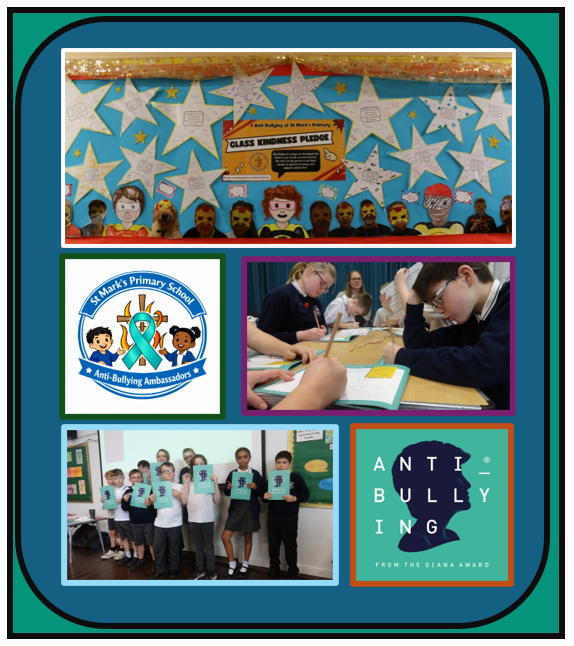 They also play a key role in shaping our school by:
Writing and updating the child-friendly anti-bullying policy and keeping anti-bullying messages current, relevant and pupil-led.
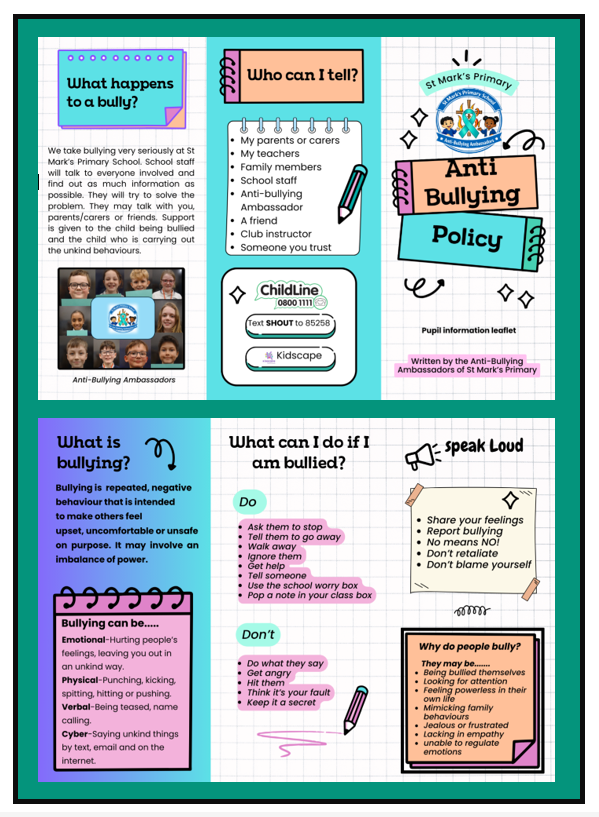 The impact on our school being part of the Diana Award has helped us to:
- Build a strong culture of kindness and respect
- Empower pupils to be come leaders and role models
- Increase confidence and voice among children
- Ensure anti-bullying work is ongoing, visible, and meaningful
At St Mark's, our work with The Diana Award reflects our commitment to:
Empowering pupils to lead change, support one another, and ensure every child feels safe, heard and valued.
How we address bullying at St Mark’s
- Offer 1:1 and group sessions through our ELSA (Emotional Literacy Support Assistant) and learning mentor sessions, focusing on positive friendships, behaviour, and bullying
- Ensure all pupils are aware of reporting bullying
- Hold assemblies reinforcing behaviour expectations
- Listen to all children who are involved
- External organisation visits promoting Anti-Bullying
- Take part in national Anti-bullying campaigns
- Provide a lunch time group to support friendships
- Have open conversations about the effects of bullying and how to report
- Challenge what 'banter' and 'roasting' and how this links to bullying
- Provide a school culture through our values of respecting others
- Follow the school behaviour and anti bullying policy
What can you do if you are worried that your child is being bullied or is a bully?
We understand that it can be upsetting and worrying if you think your child may be experiencing bullying or may be bullying another child. At St Mark's, we are here to work in partnership with you to ensure every child feels safe and supported. Please do approach school and discuss your concerns with your child's teacher, a member of the senior lead team or the DSL, Mrs Randall.
At home you could:
- Create a calm, safe space to talk
- Encourage open conversations and regular check-ins
- Remind them who they can speak to in school
- Encourage positive friendships and talk to them about what a healthy friendship looks like
- Report and block social media apps
- Show your child what is safe behaviour online and offline
- Keep texts messages, emails and voice messages that have caused concern
St Mark’s school culture
Our core Values, Hope, Honesty, Friendship, Forgiveness and Perseverance, under-pin all the social and emotional aspects of learning that we help to support your children.
Should your child ever need some extra support in this area please make sure they do not keep quiet but do indeed come and share their concerns with school staff. We work extremely hard to create an environment where children can discuss their feelings and seek support. Class teachers, pupils, support staff, and the senior team, all work together creating a culture of anti-bullying at St Mark’s and stand together and believe that bullying has a negative and often lasting impact on mental wellbeing.
/i/video/MVI_4340.mov